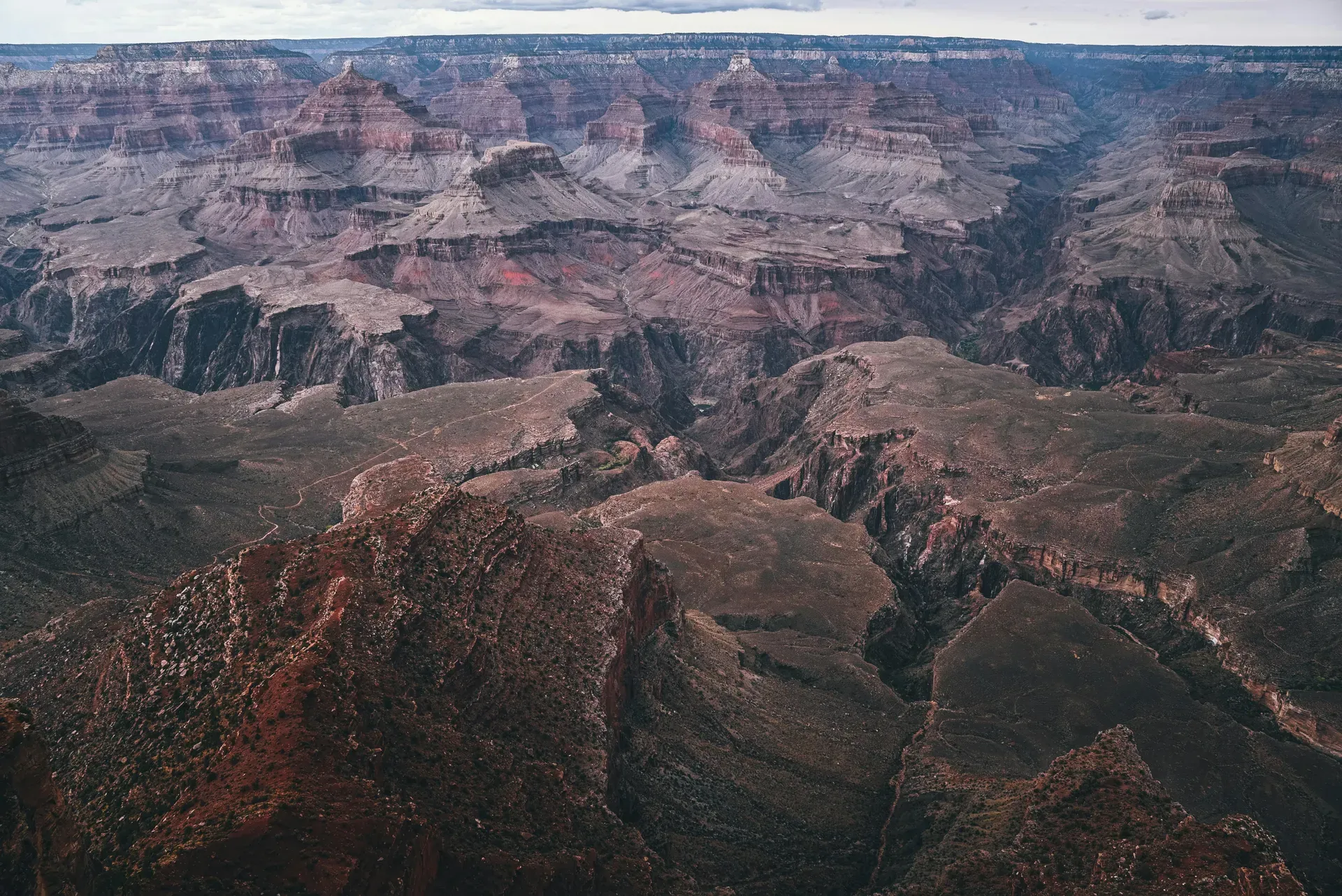
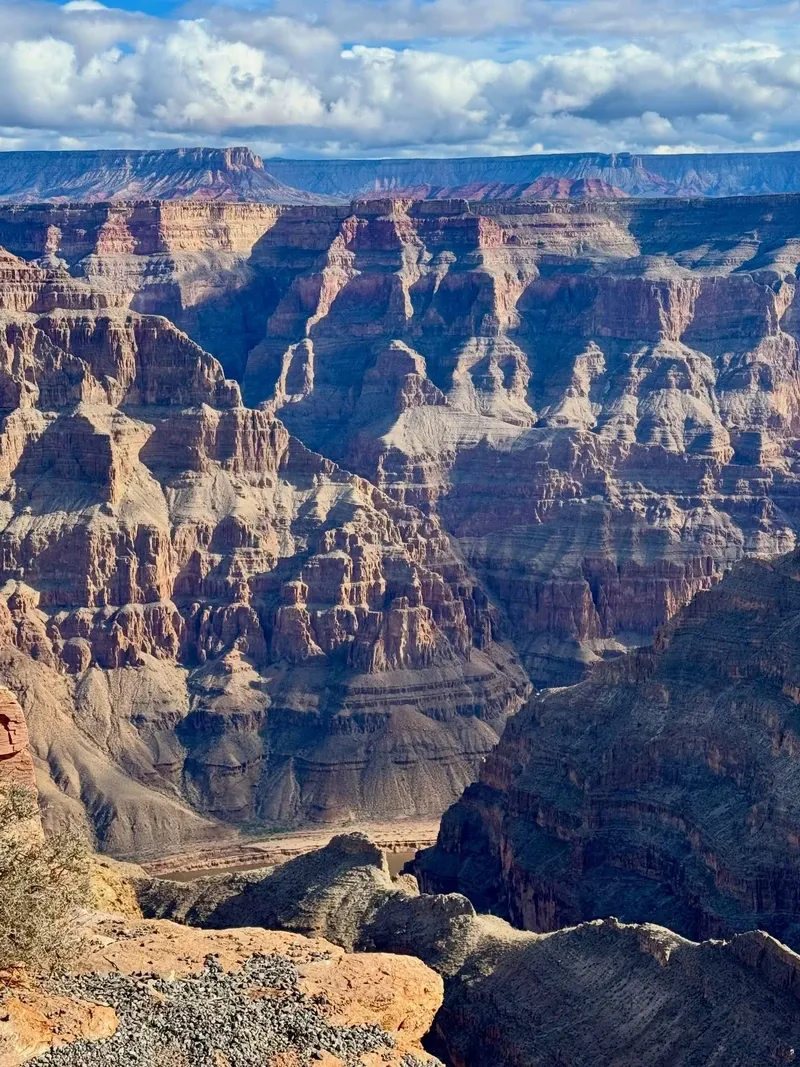
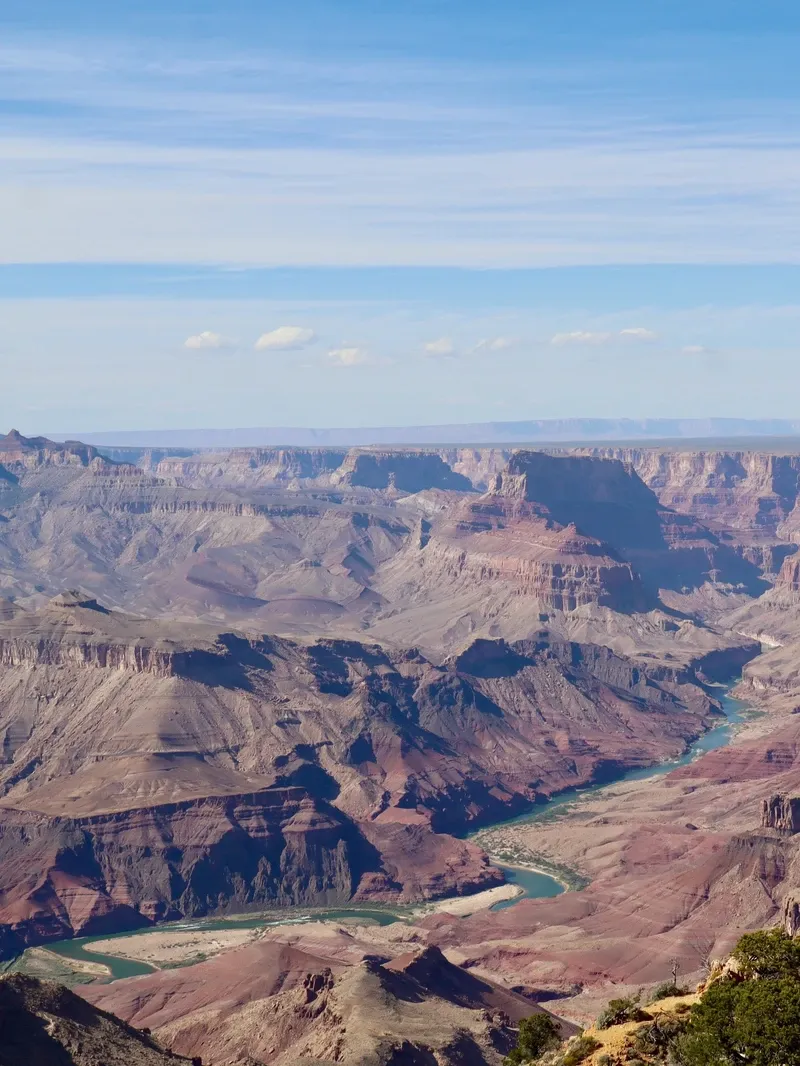
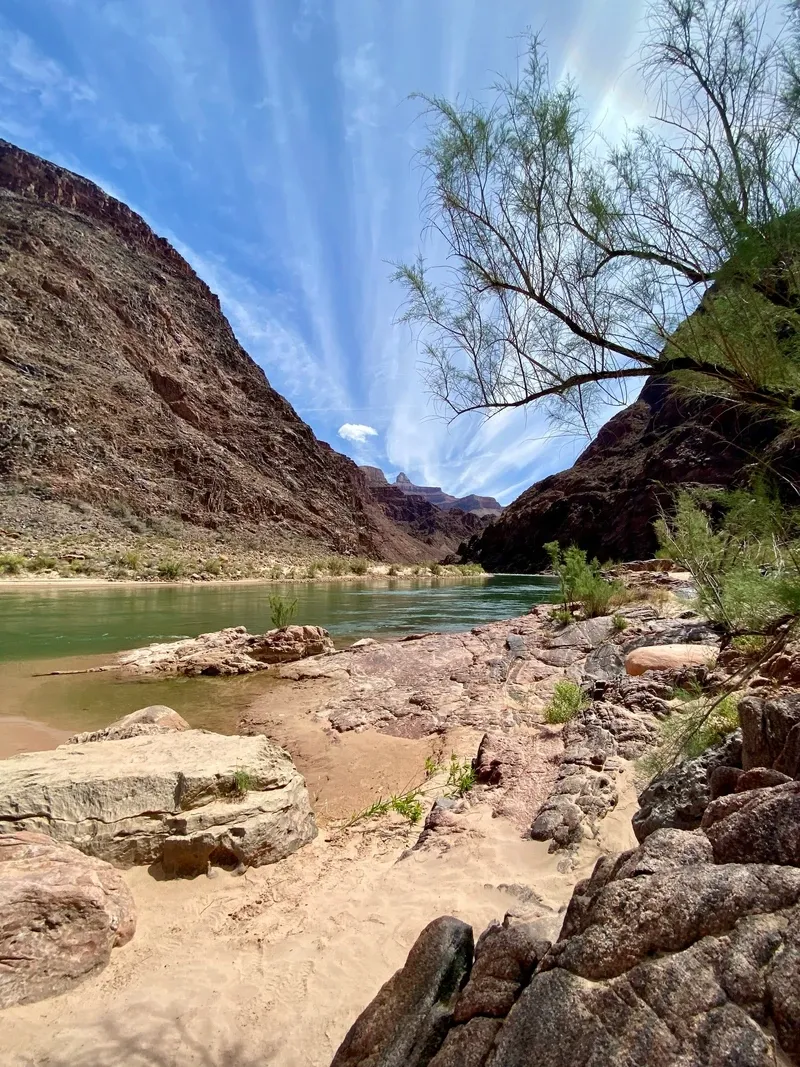
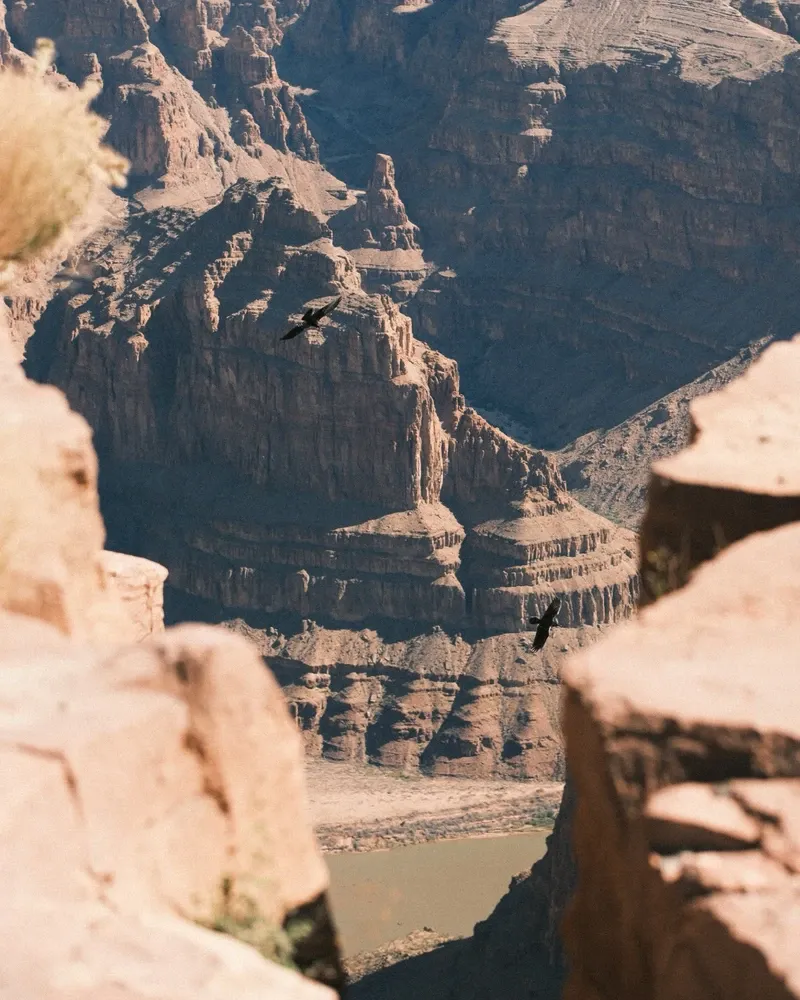
The Grand Canyon is a 277-mile gorge carved by the Colorado River into the high plateau of northwestern Arizona. It exposes nearly two billion years of Earth's geological record across a one-mile drop.
The Colorado River carved a 277-mile rift through the high plateau of northwestern Arizona. The Grand Canyon reaches up to 18 miles wide and drops a full mile down to the water. Visitors stand at the edge of 7,500-foot cliffs, looking across vast expanses of stratified red, orange, and gold rock. The temperature shifts drastically depending on your elevation. Snow frequently covers the evergreen forests on the rims, while the inner gorge bakes at over 105°F during summer months.
Six million people travel here annually to observe nearly two billion years of exposed geological history. The National Park covers 1,904 square miles, split primarily between the accessible South Rim and the remote North Rim. You can touch ancient Archean granite at the bottom or walk the paved 1.3-mile Trail of Time near the top. Mather Point gives most arrivals their first look at the massive chasm. Behind secure railings, crowds gather to watch the shifting sunlight change the color of the canyon walls.
Logistics dictate the experience. The South Rim stays open 365 days a year, operating entirely cashless for its $30 vehicle entry fee. Wait times at the entrance station routinely hit two hours during peak summer mornings. To bypass the traffic, many visitors park at the Grand Canyon Visitor Center and utilize the free wheelchair-accessible shuttle buses. The North Rim shuts down entirely from mid-October to mid-May due to severe winter weather. Hikers attempting the 215-mile driving distance between the two rims rely on the seasonal Trans-Canyon Shuttle to return to their starting point.
Native Americans have inhabited the canyon and its surrounding plateaus for at least 12,000 years. They relied on the gorge for water, salt, and shelter from the harsh plateau winters. The Hualapai, Havasupai, and Hopi tribes established permanent settlements and complex trail networks that modern hikers still use today. Spanish explorers arrived in the 16th century. Captain García López de Cárdenas led a small group of soldiers to the South Rim in 1540, searching for the fabled Seven Cities of Gold. They spent three days trying to descend to the river before giving up due to a lack of water. Father Silvestre Vélez de Escalante recorded his observations of the North Rim much later in 1776, marking the next detailed European account of the terrain. Early American prospectors and trappers largely avoided the massive rift. They viewed it as a deadly, impassable barrier rather than a destination.
John Wesley Powell launched a wooden boat expedition down the Colorado River in 1869. His team of ten men navigated dangerous rapids and mapped the inner gorge over a three-month journey. Three men abandoned the trip at Separation Canyon and were never seen again. Powell documented the distinct rock layers and recorded the sheer scale of the walls, bringing the canyon to national attention. His reports shifted public perception from fear to curiosity. Railroad companies soon recognized the commercial potential of the landscape. By 1901, the Grand Canyon Railway began transporting tourists 63 miles from Williams, Arizona, directly to the South Rim. Passengers paid a premium to ride in comfortable rail cars, avoiding the grueling stagecoach journey across the desert.
Congress designated the area as a National Park in 1919. The federal government constructed paved roads, visitor centers, and protective railings along the most popular viewpoints. Architect Mary Colter shaped the look of the park's infrastructure. She designed the Desert View Watchtower in 1932, building a 70-foot stone observation deck 23 miles east of the main village. Her designs incorporated Native American building techniques and blended directly into the natural landscape. The United Nations added the site to the World Heritage list in 1979. Today, strict regulations govern the airspace and grounds. Drones are completely banned to protect the silence and the wildlife. Visitors caught throwing objects over the edge face immediate citations, heavy fines, and potential removal from the park.
Two billion years of Earth's history sit exposed in the canyon walls. The Colorado River cuts through the uplifting Colorado Plateau, slicing through sequential layers of limestone, sandstone, and shale. At the very bottom, the inner gorge reveals dark, dense Archean granite and Vishnu schist. These base rocks formed deep underground before tectonic forces pushed the entire region thousands of feet upward. The rim elevation averages 7,500 feet above sea level. You can study these layers up close at the Yavapai Museum of Geology. The building sits right on the rim, featuring large observation windows and a tactile relief map explaining the forces that carved the gorge.
The physical dimensions dictate the local climate. The 1.6-kilometer drop creates distinct ecological zones. Ponderosa pine and Douglas fir dominate the cooler, wetter rims. Desert scrub, agave, and cacti take over the arid canyon floor. This diverse environment supports rare wildlife. Endangered California condors ride the thermal updrafts along the cliffs. Federal regulations require visitors to maintain a distance of at least 300 feet from these massive birds.
Hikers descending the Bright Angel Trail experience a temperature increase of roughly 5.5°F for every 1,000 feet of elevation lost. Summer temperatures at the river routinely exceed 105°F. The National Park Service frequently rescues hikers who underestimate the heat and fail to pack enough salty snacks to replace lost electrolytes. Erosion continues to widen the 277-mile gorge. Wind, rain, and the freeze-thaw cycle break down the softer sedimentary rock layers, causing frequent rockfalls. The South Rim features a 13-mile paved path where visitors can safely observe these sheer drops. Photographers must stay at least six feet back from unguarded edges. Lightning strikes frequently hit the exposed rim during July and August monsoon storms. If you hear thunder while standing at Hopi Point, leave the rim immediately and seek shelter inside a solid building or a metal-topped vehicle.
Eleven modern Native American tribes maintain deep cultural and spiritual connections to the canyon. The Hopi believe their ancestors emerged from the earth at a specific site within the gorge, known as the Sipapu. This sacred location represents the boundary between the physical world and the spiritual realm. The Havasupai tribe still lives inside the canyon today. They farm the land and manage tourism around their famous blue-green waterfalls, accessible only by foot, mule, or helicopter. The Navajo Nation borders the eastern edge of the park, where local artisans sell authentic jewelry and pottery near the Desert View Watchtower.
The landscape heavily influences American art and environmental politics. Thomas Moran painted massive landscapes of the canyon in the late 1800s. He hung these sweeping canvases in the U.S. Capitol to convince lawmakers to protect the region from mining and private development. Photographers like Ansel Adams later used the stark shadows and sharp rock formations to define the visual style of the American West. Their work cemented the canyon as a symbol of untamed wilderness in the national consciousness.
Modern tribal governments actively manage sections of the land outside the National Park boundaries. The Hualapai Tribe operates Grand Canyon West, located 2.5 hours from Las Vegas. They built the Skywalk, a glass-bottomed bridge suspended 4,000 feet above the floor. Visitors walk 70 feet past the canyon edge to look straight down into the chasm. The tribe strictly prohibits all personal belongings, including cell phones and cameras, on the glass. This rule prevents dropped items from scratching the floor and ensures the safety of the structure.
Launching or landing unmanned aircraft anywhere in the park results in fines and equipment confiscation.
The Grand Canyon Railway still runs a 63-mile route from Williams, Arizona, using restored vintage cars.
Federal law requires visitors to stay at least 300 feet away from endangered California condors.
The park entrance stations do not accept cash; visitors must pay the $30 vehicle fee with a card.
The Hualapai Tribe bans all cameras and phones on the Skywalk to protect the glass floor.
Inner canyon temperatures average over 105°F (40°C) during peak summer months.
The Archean granite at the bottom of the gorge is over two billion years old.
The standard entrance pass is $30 per vehicle or $25 per motorcycle. Individual entry on foot or bicycle costs $15 per person. Passes are valid for seven days.
The North Rim operates seasonally, typically opening from May 15 through October 15. It is completely closed for the 2025 season due to the Dragon Bravo Fire.
Launching, landing, or operating drones is strictly prohibited throughout the park. Violating this rule results in citations, fines, and the confiscation of your equipment.
The gorge reaches a maximum depth of approximately one mile (1.6 kilometers). The elevation drops dramatically from the 7,500-foot rims down to the Colorado River.
Driving between the South Rim Village and the North Rim Village takes four to five hours. The route covers 215 miles of remote highway.
Visitors cannot bring any personal belongings onto the glass bridge. The Hualapai Tribe enforces this ban to prevent items from dropping and scratching the floor.
The Grand Canyon Railway operates daily service between Williams, Arizona, and the South Rim. The 63-mile journey takes two hours and fifteen minutes each way.
Camping is restricted to designated campgrounds and backcountry areas. You must obtain an official permit from the National Park Service before setting up camp below the rim.
The Archean granite and Vishnu schist at the bottom of the inner gorge are the oldest exposed rocks. These formations date back over two billion years.
Spring (March to May) and fall (September to November) offer the best hiking conditions. These months provide milder temperatures and avoid the extreme 105°F summer heat of the inner canyon.
Browse verified tours with free cancellation and instant confirmation.
Find Tours